

What is a therapist to make of that IFS (Internal Family Systems) article?
Written by: Marie Chesaniuk, PhD
In October 2025, The Cut published an article entitled, “The truth about IFS, the therapy that can break you.” I’d give you an overview of the publication’s take on IFS but…I feel like the title is doing the heavy lifting for us. Based on the title alone, you’d expect that the article is generally about Internal Family Systems Therapy (IFS.) IFS is a mode of therapy originated 30 years ago by Richard Schwartz, PhD, which conceives of the mind being made up of various parts that interact with one another and can be a source of inner conflict. However, the article details a group of lawsuits involving a specific treatment facility who misused IFS parts work to incite false memories of abuse in a number of clients. Some of these clients pursued legal action against people in their lives based on these false memories, negatively impacting individuals beyond the clients themselves. Richard Schwartz, creator of IFS, was never named in any of the lawsuits and was not a therapist at this treatment facility, but had previously trained the facility’s co-founder and served as a consultant to the facility at times.
Following the publication of this article, there was a wave of discourse online and I personally received some messages from other therapist friends and colleagues asking, “What do we do with this info? Do we reassess how we use IFS?” To this I say, “Yes.” Let’s take the opportunity to reassess how we use IFS in therapy work. It’s never a bad time to update our treatment information and adjust our approach accordingly.

Since The Cut article, Richard Schwartz and his IFS Institute took the opportunity to respond to the article and discourse related to it. In this response, the IFS Institute clarifies a few points. The most relevant of these is this one: ‘The New York Magazine [New York Magazine owns The Cut] story suggests that what happened at Castlewood is representative or emblematic of IFS therapy. In actuality, the allegations at Castlewood – bullying behavior, hypersexualized interactions, imposing the therapists’ agenda, competition for therapists’ attention, and more – are contrary to the principles and practices of IFS. Moreover, IFS does not accept previously unknown, unrealized, or “recovered” memories as fact until corroborated by evidence.’ The grievances related to the lawsuits are behaviors and practices that would be considered inappropriate, unethical, and in some cases illegal by any therapeutic standard across therapeutic modalities and are not included in the practice of IFS. No therapist should be engaging in, “bullying behavior, hypersexualized interactions, imposing the therapists’ agenda, competition for therapists’ attention, and… accept[ing] previously unknown, unrealized, or “recovered” memories as fact until corroborated by evidence,’ regardless of the type of therapy they do.
The Cut article raises the concern that IFS is used more broadly (i.e., with patient populations and for diagnoses that are not currently supported by scientific research) than is warranted given the evidence currently available. To this end, it is worth checking what current research is available on IFS. Buys (2025) published a scoping review of all peer reviewed literature on IFS over the past 25 years. Buys’ (2025) review uses the National Health and Medical Research Council’s (1999) Hierarchy of Evidence to categorize and rank the evidence available for the practice of IFS. According to Buys, most available studies are qualitative case studies and thus the lowest rank of evidence (Level IV, where Level IV is the lowest tier and Level I is the highest tier of evidence), which is to say, not enough alone to warrant integrating into clinical practice. There were five quasi-experimental studies (Level III) and two randomized controlled trials (Level II) available testing IFS.
What is the current evidence available for IFS?
Promising results came from the quasi-experimental studies (see Buys, 2025 for review and citations.) Quasi-experimental studies refer to studies that use a within group control using the same participants’ pre- and post-test results to compare instead of a separate comparison group. These studies found improvements in theory of mind, self-forgiveness, reduced perceived stress and anger, reductions in PTSD symptoms, depression, dissociation, and affect dysregulation, and improvements in self-compassion, decentering, and emotion regulation.
These studies, while showing positive results and no reports of harm, would be better supported by replication by other researchers across different populations and levels of severity and by studies employing comparison groups (i.e., an IFS group compared against a waitlist or other treatment group.) The comparison group is needed to rule out possible effects of regression to the mean, effects of time passing, environmental changes (imagine the difference in effect on mood if a study started in winter and ended in summer versus starting in summer and ending in winter), the placebo effect, and other potential confounding variables that might influence results.
“Promising” results mean we should keep an eye on emerging research before we can confidently recommend and implement these interventions. “Promising” means there were no reports of harm, there were positive results on outcome measures, but due to the lack of comparison group and limited (if any) replication, we don’t know if these results are due to the intervention itself or due to the potential confounding factors listed above. If you were to implement these interventions, there is less evidence to suggest that the results are replicable in your practice: you might not get the same results, and you might not know why due to the limits of what these types of studies can tell us.
Using the California Evidence Based Clearinghouse ratings, we are aiming for the top two tiers of evidence: Tier 1 (Well-Supported by Research Evidence) and Tier 2 (Supported by Research Evidence). Tier 1 requires positive results from at least 2 rigorous randomized controlled trials whereas Tier 2 requires positive results from at least 1 rigorous randomized controlled trial. These levels of evidence provide us with a strong enough support to confidently recommend and practice a treatment for the groups and conditions studied. We can make a strong assumption that, if we were to follow the same treatment protocols, we could replicate the results of these studies for our own clients.
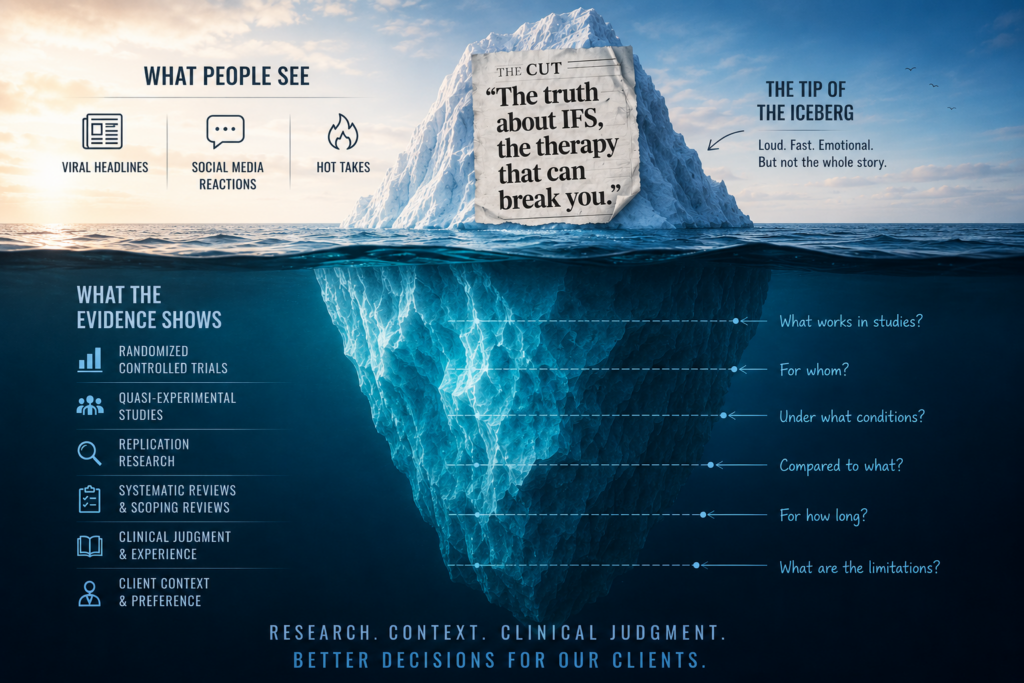
The two RCTs tested the efficacy of IFS for depression and rheumatoid arthritis (Haddock et al., 2017; and Shadick et al., 2013, respectively.) In the first RCT about IFS for depression, an IFS group was compared against a treatment as usual (TAU) group, “group which involved either CBT or IPT” (i.e., cognitive behavioral therapy or interpersonal therapy.) Due to too small of a sample size, results were not statistically significant and this limits the “rigor” of this RCT. We will likely need to wait for another RCT with a sample size sufficient to demonstrate a statistically significant (as in, not potentially due to chance) result. Though not statistically significant, both IFS and TAU groups had similar declines in depression and rated their respective treatment modalities as acceptable. The Shadick and colleagues (2013) RCT additionally measured impact on rheumatoid arthritis, a chronic health condition involving significant chronic pain, and did so over a longer period of time. Compared to an educational control group, IFS participants showed more improvement in pain level and physical function and sustained benefits in joint pain. Additionally, this study also showed improvements in self-compassion and depression a year post treatment, though no lasting effects on anxiety, self-efficacy, or disease activity.
This means we can more confidently use IFS to treat depression, increase self-compassion (this is the type of corroboration of quasi-experimental research we’re looking for!), and to help people cope with rheumatoid arthritis. These studies do not suggest IFS is superior to CBT or IPT, but is comparable to these treatments. Thus, IFS is another good option for individuals with depression and we can lean more into clinical judgment and client preference when selecting from three similarly effective treatments for depression.
Despite the popularity of using IFS to treat post-traumatic stress disorder, I couldn’t find a single meta analysis or high quality RCT of its use among trauma survivors. There are several preliminary studies that suggest it may have promise (Ally et al, 2025; Comeau et al., 2024; Hodgdon, et al., 2022), however these preliminary studies use small sample sizes and lack comparison groups, limiting our understanding of the treatment and results. We will have to wait to see if researchers can replicate and better explain how this treatment works in the trauma population with larger studies with comparison groups – which will also help us see if IFS performs worse than, on par with, or better than other treatment options. There is one small RCT (Joss, et al., 2026) testing feasibility and acceptability of group IFS for trauma survivors in a community mental health setting that demonstrates superior attendance and acceptability of the IFS option compared to a nature-based stress reduction comparison group, but both IFS and nature-based stress reduction shows equal reductions in PTSD symptoms. The sample size is small and in need of replication, but is the best evidence I could find for IFS for trauma. This suggests IFS has promise for trauma, but there is a lot we can’t know based on the current evidence and we will need to wait for more studies to accumulate more evidence before increasing our confidence in IFS for trauma.
Sources
Ally D, Tobiasz-Veltz L, Tu K, Comeau A, Blot T, Rice FK, Orr B, Bumpus C, Soumerai Rea H, Sweezy M and Schuman-Olivier Z (2025) A pilot study of an online group-based. Internal Family Systems intervention for comorbid posttraumatic stress disorder and substance use. Front. Psychiatry 16:1544435. doi: 10.3389/fpsyt.2025.1544435
Buys, M. E. (2025). Exploring the evidence for Internal Family Systems therapy: a scoping review of current research, gaps, and future directions. Clinical Psychologist, 29(3), 241-260.
Comeau, A., Smith, L. J., Smith, L., Soumerai Rea, H., Ward, M. C., Creedon, T. B., ... & Schuman-Olivier, Z. (2024). Online group-based internal family systems treatment for posttraumatic stress disorder: Feasibility and acceptability of the program for alleviating and resolving trauma and stress. Psychological Trauma: Theory, Research, Practice, and Policy.
Corbett, Rachel. (2025, October 30.) The Therapy That Can Break You Internal Family Systems is a widely popular trauma treatment. Some patients say it’s destroyed their lives. The Cut. https://www.thecut.com/article/truth-about-ifs-therapy-internal-family-systems-trauma-treatment.html
Hodgdon, H. B., Anderson, F. G., Southwell, E., Hrubec, W., & Schwartz, R. (2022). Internal family systems (IFS) therapy for posttraumatic stress disorder (PTSD) among survivors of multiple childhood trauma: A pilot effectiveness study. Journal of Aggression, Maltreatment & Trauma, 31(1), 22-43.
IFS Institute, https://ifs-institute.com/news-events/news/response-new-york-magazine-article
Joss, D., Comeau, A., Chevannes, R., Parry, G., Rea, H. S., Barria, J., Bumpus, C., Rector, A., Rajan, A., Rosansky, J., Rice, F. K., Ward, M. C., Tobiasz Veltz, L., Ally, D., Rosenberg, L. G., Sweezy, M., Lovas, D., & Schuman-Olivier, Z. (2026). A randomized controlled trial of an online group-based internal family systems treatment for posttraumatic stress disorder: The Program for Alleviating and Resolving Trauma and Stress (PARTS) study. Psychological Trauma: Theory, Research, Practice, and Policy. Advance online publication. https://dx.doi.org/10.1037/tra0002089

About Us
Learn more
Our Care
Learn more
What We Treat
Learn more